GraphRAG that traverses what vectors miss
When relationships drive the answer, similarity is not enough. We design and ship GraphRAG systems on Neo4j, Neptune and TigerGraph, built for interactive-latency traversal at enterprise scale, with cited and auditable answers.
7
stages from source event to cited answer
4
graph stores we deploy, chosen per workload
20
questions workshopped before any schema is drawn

Five problems knowledge graphs solve
These failure modes show up every time the data has structure that matters — and none of them are solved by adding more chunks to a vector store. They need explicit edges, resolved entities and traversal.
Vector-only RAG misses relationships
Cosine similarity finds related chunks but cannot traverse 'customer → account → contract → supplier' chains.
Answers look plausible but skip the connective tissue that drives real decisions.
Entity duplication across source systems
The same vendor exists as eleven different records across the CRM, the finance system, procurement and the issue tracker.
Reporting double-counts spend, investigations stall on alias resolution, and two dashboards disagree.
Multi-hop questions take days
Questions like 'which open issues touch services owned by teams reporting to this VP?' need four joins across three systems.
Decision latency stretches from hours to weeks, and the ad-hoc query backlog grows.
Answers without citations are unsafe
Generative answers that cannot be audited back to source nodes will not clear compliance, legal or risk.
Pilots stall at the security review and the rollout never happens.
Schema sprawl in heterogeneous data
Every wiki, chat tool, CRM and repository arrives with its own object model and its own identifiers.
Every new question needs bespoke extraction, so the data team scales linearly with use cases.
The GraphRAG pipeline, end to end
Seven stages from a raw source-system event to a cited natural-language answer. Each stage is independently observable and replaceable.
Ingest
Change-data-capture events streamed from the wikis, chat tools, CRM, code hosts and service desks the business already runs.
Kafka · Airbyte · Debezium
Entity extraction
A hybrid pipeline — a fast NER model for high-volume structured fields, a language model for long-form unstructured documents. Output validated against a typed entity schema.
spaCy · Claude · Pydantic
Entity resolution
LSH blocking narrows the candidate pairs; a classifier merges duplicates. Low-confidence matches route to a person rather than being guessed.
LSH · embeddings · Claude
Relation extraction
Typed edges extracted from text and structured joins. Provenance preserved — every edge cites its source record, and edges are versioned rather than overwritten.
Claude · rule engine · Pydantic
Graph store
Loaded into the store chosen for the workload, with indexes tuned for the top-twenty query patterns identified during schema design.
Neo4j · Neptune · TigerGraph · Memgraph
GraphRAG query
The user's question becomes Cypher, executes, and fuses with hybrid vector retrieval before the model reasons over the result.
LangChain · Cypher · Qdrant · Claude
Cited response
Every answer carries citations back to the source nodes and edges it used, so compliance, legal and risk can audit any claim it makes.
Pydantic · Datadog · audit log
Six capabilities, every component named
Every component is named, replaceable and observable — no black box, and nothing you cannot take with you.
Polyglot graph store
Neo4j AuraDB for general workloads, Amazon Neptune for AWS-native deployments, TigerGraph for deep traversals on billion-edge graphs, Memgraph for streaming analytics. We pick per workload.
Entity resolution, validated against your own labels
Two-stage resolution — LSH blocking, then a classifier combining string similarity, structural graph features, and model reasoning for ambiguous cases, measured against labels you supply.
Streaming ingest
Change-data-capture from your source systems via Kafka or Airbyte. The graph stays fresh incrementally — no full nightly rebuilds, no stale traversals.
GraphRAG query layer
A chain that translates natural language to Cypher, executes it against the graph, then feeds the structured results plus hybrid vector hits into the model for cited reasoning.
Schema enforced in code
Every entity type, relation and model output is validated against typed schemas. Schema drift fails loudly in CI rather than silently in production.
Query observability
Latency per query type at p50, p95 and p99, cache hit rates, slow-query traces and embedding-call cost. We tune the schema and indexes until the targets hold under your load.
Where a graph pays for itself
Five domains where the question itself is a traversal, and the answer cannot be reached any other way.
Financial services
KYC and AML investigations
Resolve beneficial-owner networks across the CRM, transaction systems and external watchlists. Multi-hop traversals surface indirect exposure that flat lookups miss.
A multi-family-office platform uses the graph to answer KYC-refresh questions that previously required re-reading the source documents for every entity.
Pharma and life sciences
Drug, target and pathway reasoning
Unify internal trial data with public ontologies into one graph, so a researcher can ask which targets in a portfolio share pathways with approved drugs.
Built so a hypothesis-level question is one traversal, not a multi-day literature triage.
Legal
Case-law cross-citation
Graph every internal matter, opinion and external citation, so precedent chains, conflicting rulings and jurisdiction patterns come back from a single query.
Built so a conflict check is a single graph query rather than a manual cross-system search.
Engineering and manufacturing
Parts, supplier and defect networks
Link bills of materials, supplier contracts, defect reports and field-failure data, so a defect spike returns the affected items, customers, suppliers and warranty exposure together.
Built for the moment a defect spikes: a single traversal answers 'what else does this touch?', replacing manual cross-referencing of BOMs, defect logs and warranty records.
Customer success
Account, contact and deal intelligence
Merge CRM records, message history, call transcripts and product telemetry into one customer graph, so every touchpoint, champion and blocker sits in a single view.
Built to surface at-risk accounts from relationship signals a per-system view cannot see.
A phased delivery, not a discovery exercise
The schema comes from your top-twenty questions, so the graph is shaped by what you need to ask rather than by what happened to be in the source systems.
Weeks 1–6
Schema and ingestion
Workshop the top-twenty questions the graph must answer. Design entity types, relation types and the provenance model. Stand up connectors to three to five source systems and load the first entities.
Weeks 7–14
GraphRAG query layer
Build the query pipeline, hybrid retrieval and reasoning step. Stand up the evaluation harness with a golden question set across the priority use cases.
Weeks 15–18
Production hardening
Observability, latency tuning, a cache layer, role-based access in the graph store, audit-log export and cutover. Evaluation gates block any regression on the golden set.
Ongoing
Expansion
Add the remaining source systems through the same pattern, and layer in new entity types as new use cases arrive. New questions stop costing engineer-weeks.
Every answer cites the nodes it used
An answer nobody can audit is an answer compliance will not let you ship.
Provenance is carried at the edge level, not bolted on at the end: every relationship records the source record it came from, and edges are versioned rather than overwritten, so an answer given last quarter can still be explained this quarter.
Deep dives from our engineering team

When is vector RAG enough, and when do you actually need GraphRAG?
GraphRAG is powerful and expensive, and most teams reach for it too early. Here's the honest decision rule — the questions about your data and your queries that tell you whether vector RAG is already enough.
Read more3 min read
Why Your AI Agent Keeps Forgetting
Your agent does not have a memory problem. It has a memory architecture problem. The four kinds of agent memory, where each one lives, and why a context window was never going to be enough.
Read more12 min read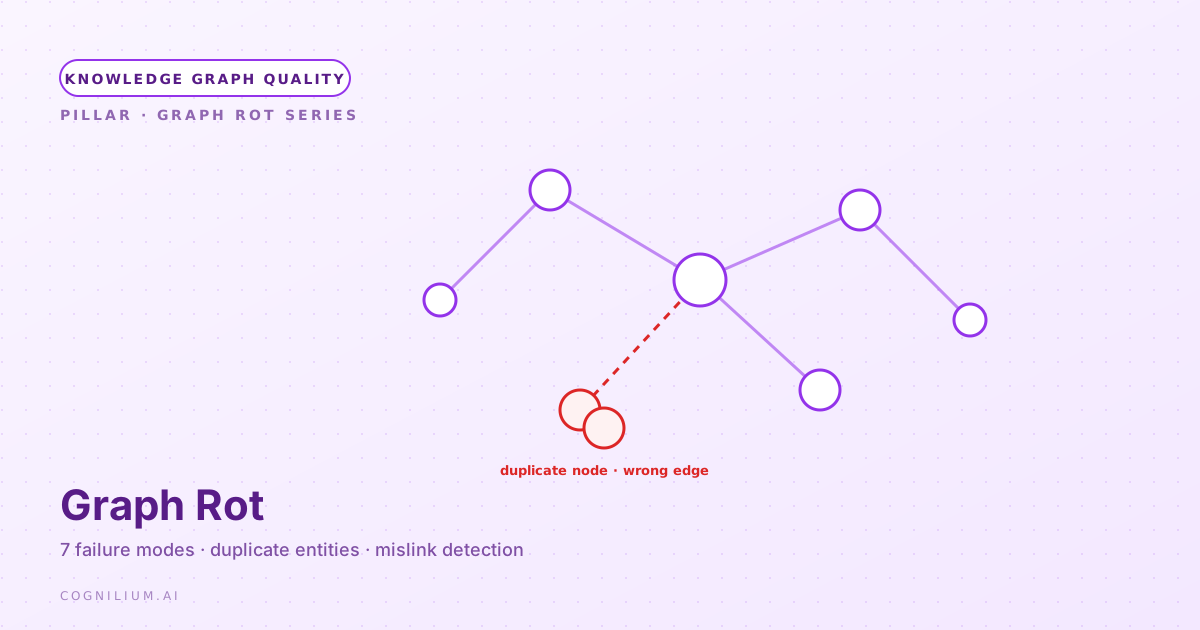
Graph Rot: Why Your Knowledge Graph Is Lying to Your AI
Graph rot is the silent decay of a knowledge graph's correctness. The 7 ways production graphs go bad, from an engineering team that builds them.
Read more6 min read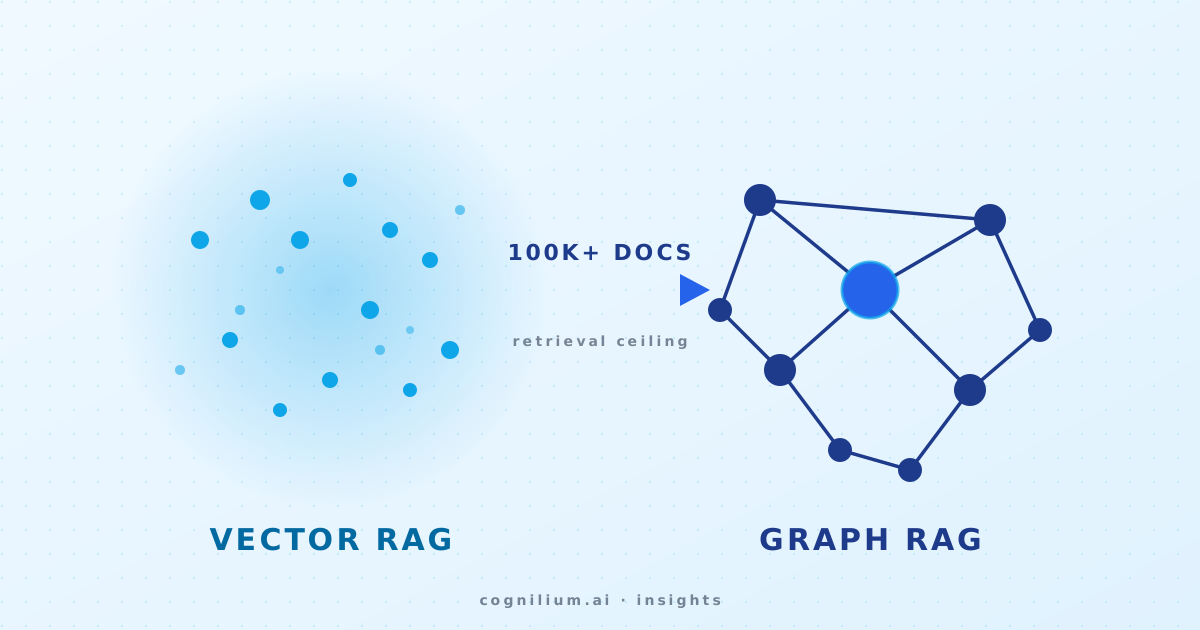
RAG vs GraphRAG: When the Vector Database Stops Being Enough
Plain vector RAG hits a ceiling around 100K documents. This is where graph-augmented retrieval becomes the right tool — and how to know if you need it.
Read more12 min read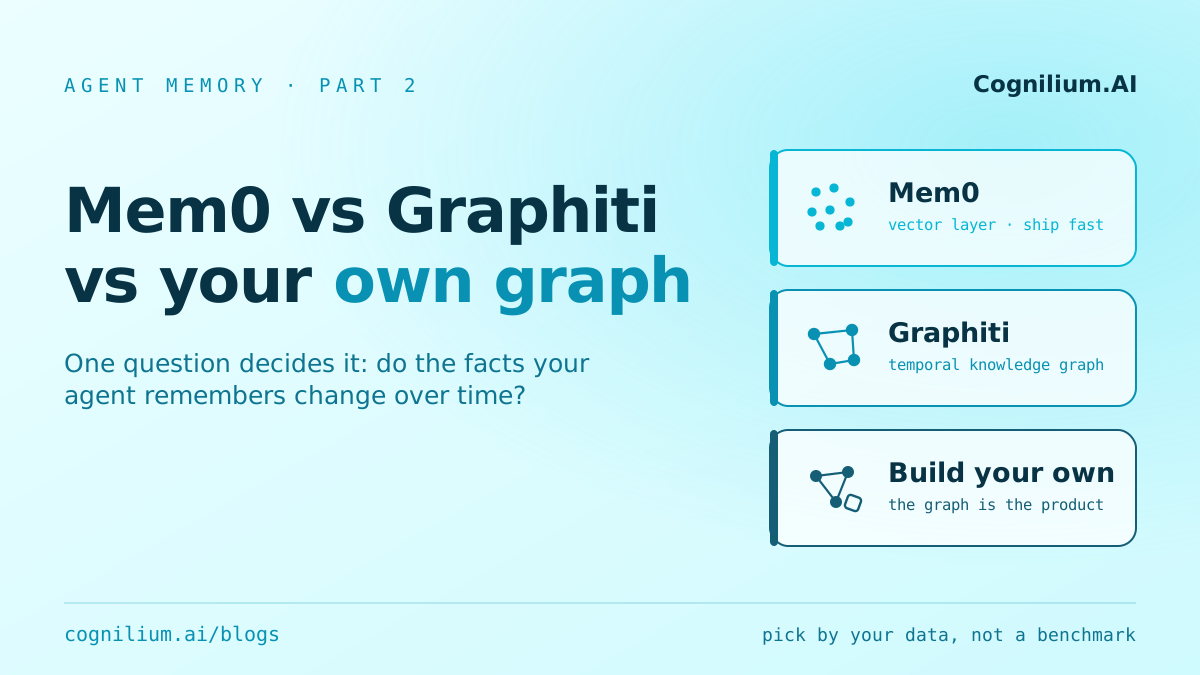
Mem0 vs Graphiti vs Building Your Own Graph
Graphiti models memory as a temporal graph; Mem0 extracts and stores facts. The difference shows up in what each one can answer months later.
Read more13 min read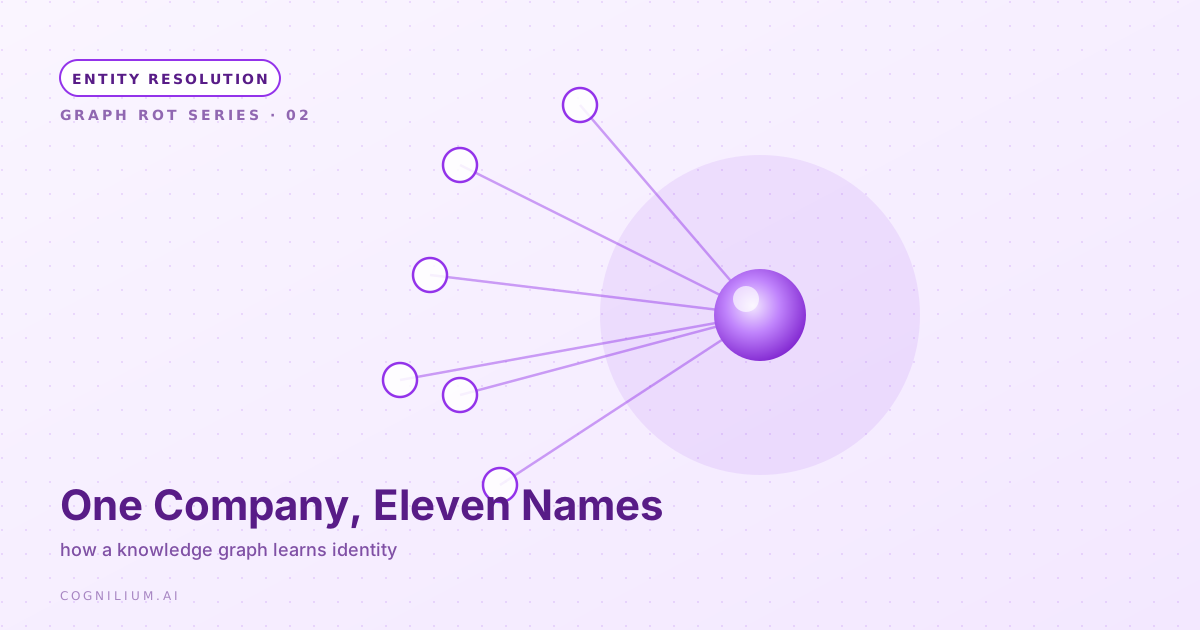
One Company, Eleven Names: How a Knowledge Graph Learns Identity
Extraction gives you names. Entity resolution decides identity. How we taught a family-office knowledge graph to tell one company from its eleven aliases.
Read more10 min read
Hybrid Retrieval With Prefetch-Time Metadata Filtering
Why filtering after RRF fusion loses the right chunks, and how a "drop trait → mode → grade" progressive relaxation ladder keeps narrow queries answerable without dropping retrieval quality.
Read more8 min read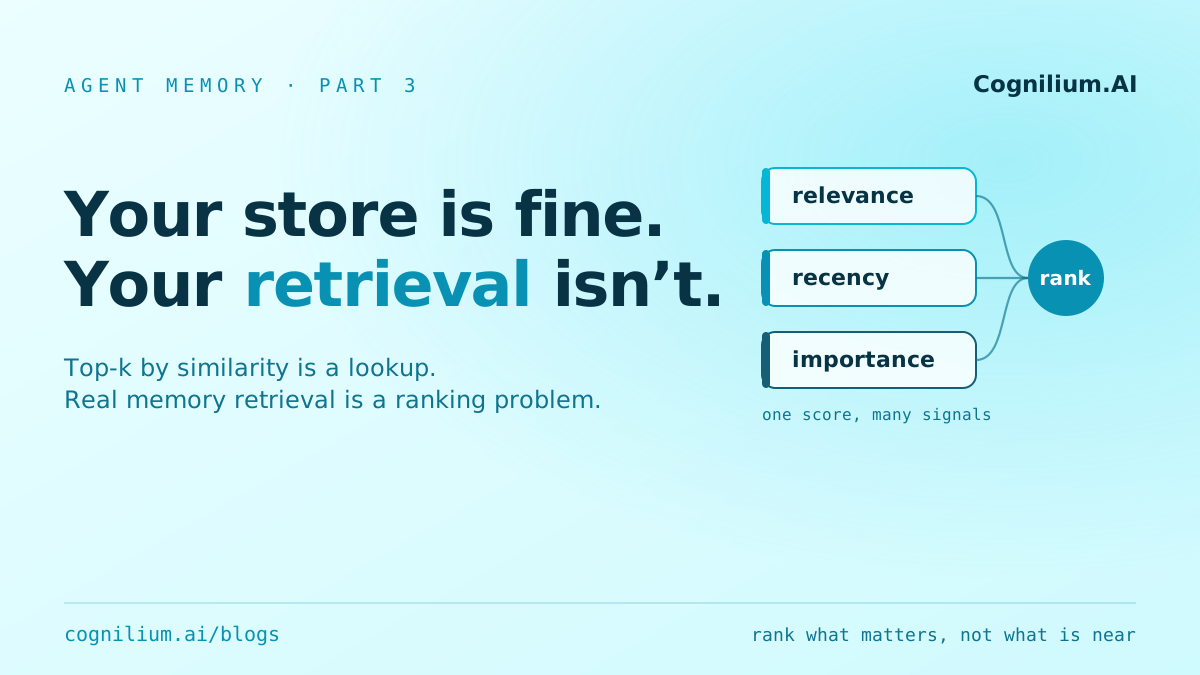
Why Your Agent Retrieves the Wrong Memory
Your agent’s memory store is probably fine. Its retrieval is the bug. Top-k by similarity is a lookup; production memory retrieval is a ranking problem. How to rank by relevance, recency, and importance, retrieve then rerank, combine vector, keyword, and graph, and assemble it all into a limited window.
Read more15 min read
Let us design your graph schema
This is our AI engineering practice
It is real work and it is where our four products came from. But what Cognilium leads with is narrower: optimization apps that run in tandem with Microsoft Dynamics 365, computing the decisions the ERP records but does not derive — the optimal price, the optimal pick path, the optimal stock level. See the optimization apps · How we build inside the ERP.