TL;DR
Graphiti models memory as a temporal graph; Mem0 extracts and stores facts. The difference shows up in what each one can answer months later.
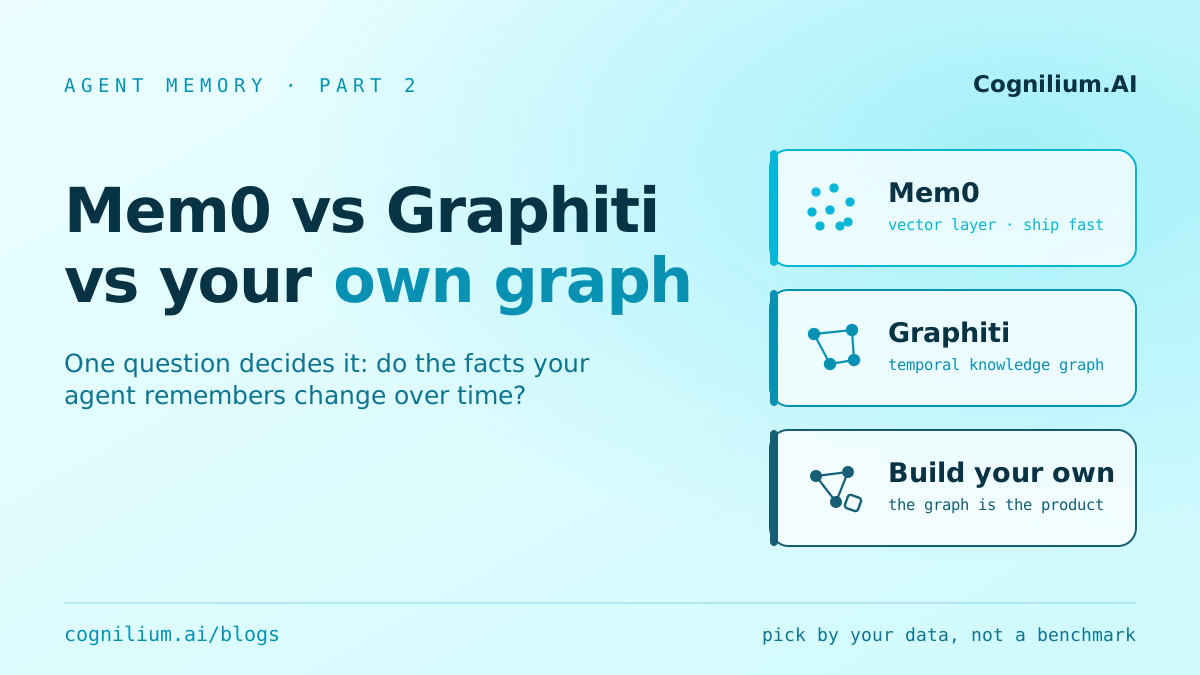
TL;DR: Almost everyone asks the wrong first question. It is not "which agent memory framework is best," it is "do the facts my agent remembers change over time, and do I need to reason about when they changed?" If yes, you want a temporally-aware graph, and Graphiti is built for exactly that. If no, which is true for most agents, a vector-first memory layer like Mem0 is cheaper, faster to ship, and enough. Building your own graph is the right call only when the graph is your actual product. Every public benchmark in this space is run by a vendor selling one of the answers, so this post compares the three on architecture and real cost instead, including the costs nobody quotes you. We build knowledge graphs for a living, which is exactly why we will tell you when not to.
"Should we use Mem0 or Graphiti?" is now one of the most common questions we get from teams building agents. It is a fair question, and it almost always arrives framed as a benchmark shootout: which one scores higher, which one is faster, which one wins. That framing is the first mistake. These two tools are not faster and slower versions of the same thing. They are different shapes of memory, and the right one is decided by your data, not by a leaderboard.
This is the second post in our series on agent memory. The first one made the case that an agent forgets because it has a context window and not a memory, and that real memory is a layered system of working, episodic, semantic, and procedural stores living outside the prompt. This post zooms into the decision most teams hit right after that realization: once you accept you need a durable memory layer, what do you actually reach for? We will be specific, we will name what each tool is genuinely good at, and we will disclose our own bias up front, because everyone else in this comparison has one too.
The question is not which memory framework wins a benchmark. It is which shape of memory matches the way your facts actually behave.
First, what these tools actually are
Strip the marketing and the two are easy to tell apart.
Mem0 is a memory layer that is vector-first. When your agent has an exchange, Mem0 sends it to a language model that pulls out the salient facts, "this user prefers email over calls," "they work at a logistics company," and stores those facts as embeddings it can later retrieve by similarity. On the way in it also reconciles: it checks the new fact against similar existing ones and decides whether to add, update, or leave them alone, so the store does not fill with duplicates. It is open source under a permissive license, it self-hosts, and it plugs into a long list of vector databases. Its whole design optimizes for one thing: remember the durable facts about a user or a task, cheaply, and surface them fast.
Graphiti, from the team behind Zep, is a different animal. It builds a temporal knowledge graph. Instead of storing loose, unanchored facts, it extracts entities and the relationships between them and writes them into a graph as nodes and edges, where every edge carries time. That last part is the whole point and it is worth slowing down on. Graphiti's model is bi-temporal: each fact knows both when it became true in the real world and when the system learned it, and those are tracked separately. When a new fact contradicts an old one, Graphiti does not delete the old edge. It marks it invalid as of the moment the new one became true and keeps it. The graph remembers not just what is true now, but what used to be true and when that changed. Like Mem0 it is open source, but unlike Mem0 it requires you to stand up and run a graph database underneath it.
That single architectural difference, facts-by-similarity versus facts-on-a-timeline, is the fork the entire decision hangs on.
The one question that decides it: do your facts change over time?
Here is the test we walk every team through before they touch either tool.
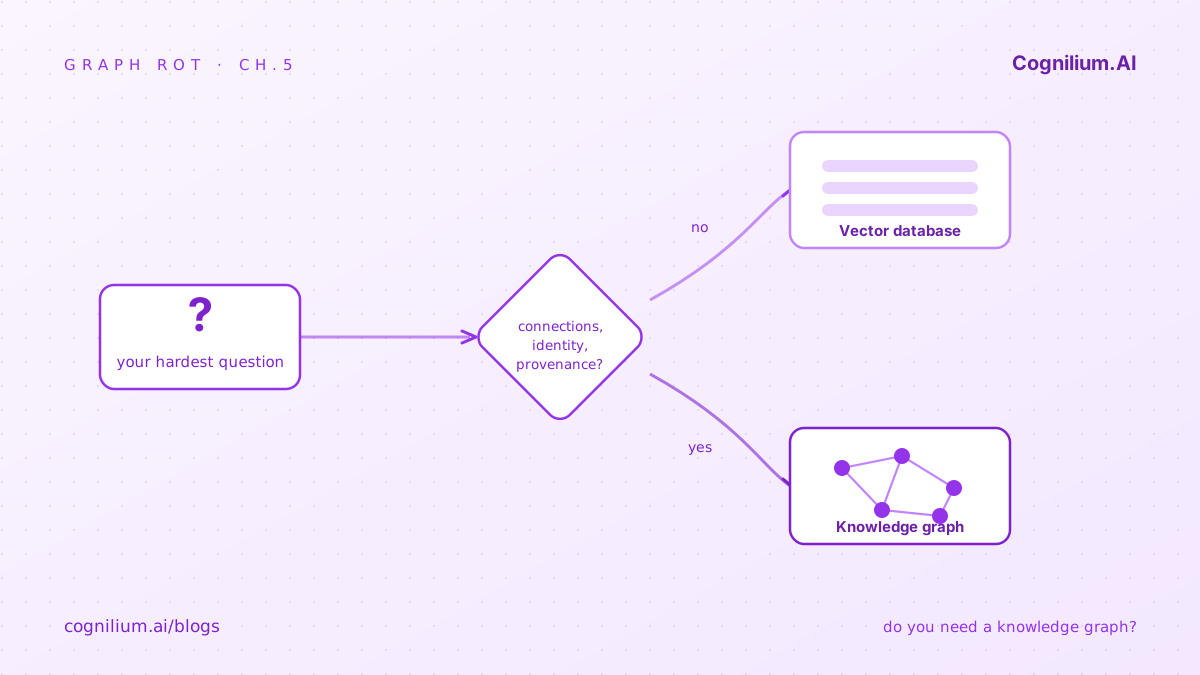
Take the things your agent needs to remember and ask, for each, whether it changes and whether the history of the change matters. A user's communication preference, a customer's recurring problem, a person's dietary restriction: these are mostly stable, and when they do change you usually only care about the current value. That is a similarity-retrieval problem. A vector memory layer handles it well, and reaching for a graph would be carrying a structure you will not use.
Now take a different class of fact. Who currently owns this asset, and who owned it before. What tier this account was on in March versus today. Which clause in the contract is in force now that an amendment has superseded the original. Where this person worked across the last three years. These are facts with a lifespan, and the questions you ask of them are temporal: not just "what is true" but "what was true then" and "when did it change." This is precisely what a bi-temporal graph is for, and it is precisely what a vector store cannot do, because a vector store has no native sense of time. It retrieves what is closest in meaning to your query, and a superseded fact can sit closer to the query than the correction that replaced it. So the store hands the agent the old answer, in the same confident voice, and the agent has no way to know it is stale.
Mem0's own engineering writing names this exact failure: a highly-retrieved memory about someone's employer is accurate right up until they change jobs, at which point it becomes confidently wrong. That is not a bug in Mem0, it is the natural limit of similarity retrieval without a timeline. The lesson is not "vector memory is bad." It is that the moment your agent's correctness depends on knowing when a fact was true, similarity alone stops being enough, and you have crossed into graph territory.
So: do your facts change in ways where the history matters? If you genuinely do not know, that is itself a finding, and it is the kind of thing a short scoping conversation settles fast. Most teams, once they actually sort their facts into the two piles, are surprised by how few land in the temporal one.
What Mem0 is genuinely good at
We are a graph shop, and we will still tell you plainly: for a large share of agents, Mem0 is the right answer and a graph would be overkill.
Its real strengths are integration speed and operational lightness. You can add it to an existing agent in a few lines and have persistent user memory working the same day, with no new database to run if you use the managed option. Its sweet spot is personalization: assistants and support agents that get better because they remember who they are talking to and what that person cares about. Because it stores extracted facts rather than raw transcripts, it is structurally cheaper than stuffing history back into the prompt, which is the trap the first post in this series was about. And because it is permissively licensed with broad backend support, you are not locked into anyone's cloud to start.
If your agent's memory needs are "know the user, remember their preferences and past issues, do not make them repeat themselves," and those facts are mostly stable, Mem0 is fast, mature, and well-resourced. Adopting it is a half-day decision, not a quarter-long project. Picking the heavier tool here does not buy you anything except a database to babysit.
What Graphiti is genuinely good at
Graphiti earns its added weight in exactly the place Mem0 thins out: facts that evolve, and questions about relationships across several hops.
Three things make it strong. First, the bi-temporal model means it can answer "what was true before the change" without you building that logic yourself, which matters enormously for anything audit-like, compliance-like, or simply any domain where the past state is part of the answer. Second, because it is a real graph, multi-hop reasoning is native: "trace how this entity connects to that one through the parties in between" is a traversal, not a prayer over a pile of similar paragraphs. Third, it ingests incrementally and in real time, so the memory updates as events arrive rather than waiting for a nightly rebuild, and its retrieval path combines semantic search, keyword search, and graph traversal without putting a language model in the hot path of a query, which keeps reads quick.
If your agent operates somewhere that relationships are dense and facts have a history that matters, finance, legal, healthcare, anything regulated, anything where "as of when" is a real question, Graphiti's architecture is doing work that a vector store fundamentally cannot. That is the case it is built for, and inside that case it is excellent.
The cost nobody quotes you
Here is where the vendor comparisons go quiet, and where building agents for a living actually pays off, because we run these systems and see the invoices.
A graph framework extracts. Every time you write to it, it calls a language model to pull entities and relationships out of the text and reconcile them against what is already in the graph. That is not without cost, and it is not a rounding error at volume. One independent engineer's published head-to-head put the graph framework at roughly 1.7 times the total token cost of the vector approach over the same workload, for the simple reason that the graph does more extraction work on every write. Mem0's own paper shows the same direction internally: turning on its optional graph memory roughly doubled the token cost for a small accuracy gain. The pattern is consistent. Richer structure on write costs more tokens on write.
Put rough numbers on it so it stops being abstract. Say your agent's memory extraction is already costing a few hundred dollars a month in model calls on a vector setup, call it three hundred. The same workload on a graph framework, at 1.7 times, is closer to five hundred and ten, every month, indefinitely, and that is before you have paid for a single node of the graph database you now have to operate. Which is the second hidden cost: with Graphiti you are not just adopting a library, you are taking on running Neo4j or FalkorDB in production, with the scaling, backups, and three-in-the-morning pages that come with operating a database. The convenient all-in-one self-host path that used to exist on the Zep side was deprecated, so self-hosting today means you own that database.
None of this makes the graph wrong. It makes it a real decision with a real recurring line item. The whole point of the question two sections up is to make sure you are paying that tax because your facts genuinely need a timeline, not because a benchmark made the graph look like the premium choice.
Don't trust the benchmarks, including the one we'd run
You will find numbers everywhere. Tool A scores ninety-something on this benchmark, tool B beats it by fifteen points on that one. Treat all of them with suspicion, including any we might publish, and here is the concrete reason why.
Every headline benchmark in this space is run by a vendor that configured both its own system and the baselines it is beating. The benchmark datasets are often third-party and legitimate, but the comparison results are produced by an interested party. The clearest tell: the two leading tools here have publicly disputed each other's scores on the same benchmark, with one side correcting its own published number downward and then accusing the other's corrected number of being wrong in turn. When the vendors cannot agree on the leaderboard, the leaderboard is not your decision criterion.
There is a subtler trap underneath the numbers. The benchmark on which the graph approach most clearly beats the vector approach is a test of temporal, multi-session memory, facts that change across time. Of course the graph wins there. That is the one thing the graph is for. If your agent does not have that kind of memory need, a high score on that benchmark tells you nothing about your situation. You would be choosing the heavier, costlier tool on the strength of a test that does not resemble your workload. Do not optimize for a benchmark that is not your use case. Optimize for the shape of your own facts.
The third option: build your own graph
There is a path the framework comparisons tend to skip, which is to not adopt a memory framework at all and build the graph yourself on top of a database you control. We do this for clients, so let us be precise about when it is right and when it is a trap.
Build your own when the graph is your product, not a supporting feature. If your core value lives in a carefully curated domain graph with an ontology you designed, then a framework's auto-extracted graph is a second graph you now have to reconcile against your real one, which is worse than having no framework at all. Build your own when you need a bespoke schema that an LLM's open-ended extraction will not respect, when scale is modest enough that the framework's machinery is more than you need, or when you must control exactly what triggers a model call and where the data lives.
But be honest about what building gets you, because this is the line teams cross too casually. Standing up Neo4j and writing entities into it gives you a graph. It does not give you a memory system. The hard parts, the parts the frameworks spent two years on, are not the storage. They are invalidating facts when they are superseded, resolving duplicates so one entity is not stored under five names, ranking by recency and relevance so the right slice surfaces, and consolidating noisy inputs into settled facts. "We will just use Neo4j" almost always under-budgets that second layer, and the project that was supposed to take two weeks discovers it has signed up to rebuild, badly, the thing it could have adopted.
This is the work we do, so the anonymized shape of one real build is useful here. On a wealth-management platform, the semantic memory is a graph in Neo4j with six entity types and five relationship types, populated by an eight-stage extraction pipeline that pulls entities and relationships out of unstructured documents, resolves duplicates, and checks every candidate edge against the sentence that justifies it before writing it. A vector store of a few hundred chunks sits alongside it for plain similarity recall, and every fact in the graph carries a confidence score from zero to one so the agent can keep its shakiest memories out of its most important answers. That is a deliberately built memory system, and it exists because that domain needed a schema and a quality bar no general framework would have enforced. It was the right build. For a personalization chatbot, the same effort would have been malpractice.
If you want the honest version of this call for your own situation, we wrote a whole buyer's post on whether you actually need a knowledge graph at all, and the same series covers how graphs rot, how to keep one fresh, and how to run a twenty-minute health check on one once you have built it, because the build is the start of the maintenance, not the end of the work.
So which should you actually pick?
Compress everything above into a few rules you can act on.
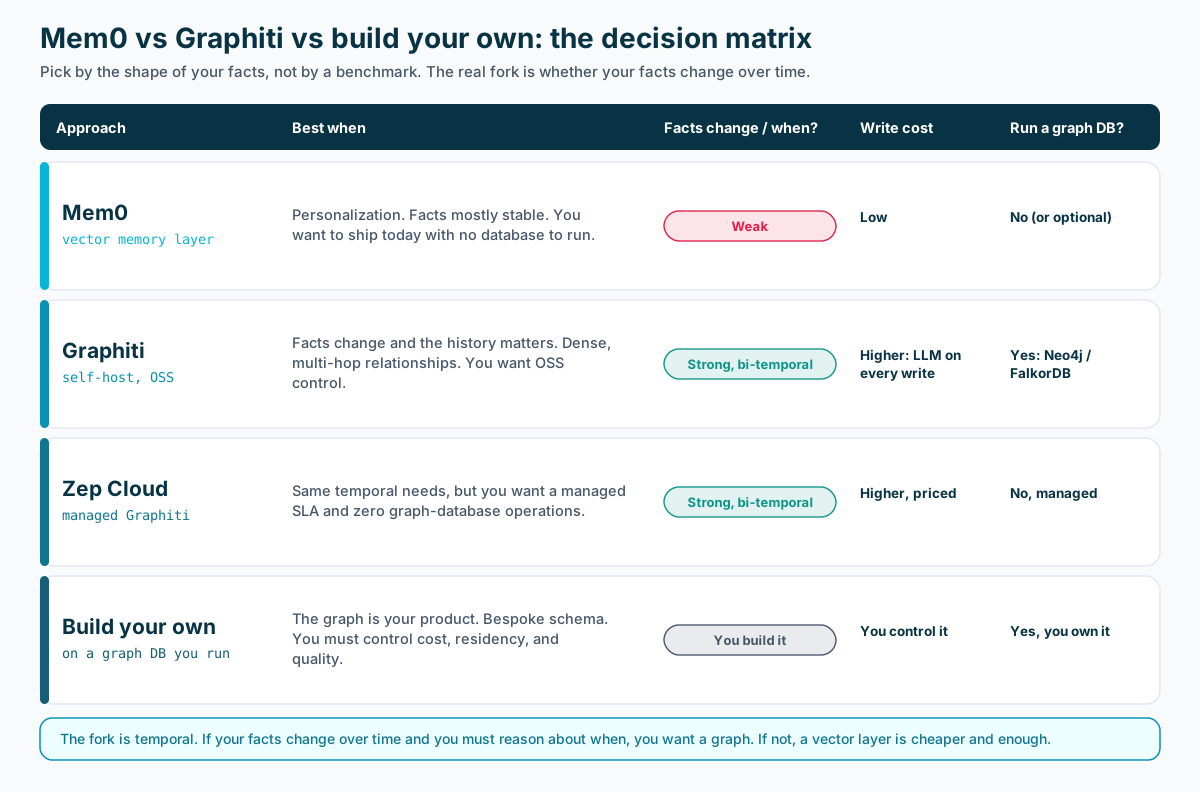
Pick Mem0 when your agent needs to remember durable facts about users or tasks, those facts are mostly stable, and you want to ship today without operating a database. This is most agents. Do not let benchmark envy talk you out of the simple, cheaper tool that fits.
Pick Graphiti when your facts change over time and the history matters, when relationships are dense and multi-hop, and when you are willing to run a graph database and pay an extraction cost on every write to get correctness a vector store cannot give you. If you want those temporal capabilities but not the database operations, the managed cloud built on it is the same architecture with the ops handed off, at a price.
Build your own graph when the graph is the product, the schema is bespoke, or control over cost, residency, and quality outranks time-to-first-value, and go in knowing that the storage is the easy ten percent and the memory logic on top is the other ninety.
And underneath all three, remember the point from the first post: storing memory is the easy half, retrieving the right slice at the right moment is where systems are won or lost. Whichever tool you pick is a store. A small model with a well-tuned memory will beat a large model with a badly-wired one, every time. The tool is the smaller decision. The wiring is the larger one, and it is the subject of the next post in this series.
Trying to decide between adopting a memory framework and building the graph yourself? That build-versus-buy call, scoped to your actual data and your actual cost ceiling, is work we do every week. Book a 15-minute call and we will tell you honestly which of the three this post describes is right for you, even when the answer is the one we do not get paid to build. We work US business hours.
Share this article
Agent Memory & Context Graphs
Topic Cluster
Context graphs and durable agent memory, built on the same retrieval layer.

Mudassir Marwat
Founder & CEO, Cognilium AI
Mudassir Marwat
Founder & CEO, Cognilium AI
Mudassir Marwat's argument is that ERP systems record decisions they never optimise.