TL;DR
Your agent’s memory store is probably fine. Its retrieval is the bug. Top-k by similarity is a lookup; production memory retrieval is a ranking problem. How to rank by relevance, recency, and importance, retrieve then rerank, combine vector, keyword, and graph, and assemble it all into a limited window.
TL;DR: Your agent's memory store is probably fine. Its retrieval is the bug. The default move, top-k by cosine similarity, is a lookup, and a lookup has exactly one signal while relevance has many. Production memory retrieval is a ranking problem: score candidates by relevance plus recency plus importance, the way Stanford's Generative Agents did back in 2023; retrieve in two stages, a cheap wide recall pass then an expensive precise rerank; combine vector, keyword, and graph search because each one is blind where the others see; then assemble the survivors across your memory layers into a limited window, in the right order, because position itself changes the answer. The shift in one line: stop asking "what is most similar" and start asking "what should rank highest for this decision." A small model with well-ranked memory beats a large model with badly-ranked memory, every time.
An agent gives the wrong answer. You check the database, and the right fact is sitting right there, correctly stored. The model had access to it. It just never saw it, because the retrieval step handed it five other things instead. This is the most common production failure we get called in to fix, and it is almost never a memory-storage problem. It is a retrieval problem wearing a storage costume.
This is the third post in our series on agent memory. The first post made the case that an agent forgets because a context window is not a memory, and that real memory is a layered system of stores living outside the prompt. The second post compared the tools you reach for to build that store. Both ended on the same warning: storing memory is the easy half. Getting the right slice of it onto the agent's desk at the right moment is the half where systems are quietly won or lost. That half is retrieval, and this post is about why it is harder than it looks and what doing it properly actually requires.
The store is the smaller decision. The retrieval is the larger one. A correct fact the agent never surfaces is, from the agent's point of view, a fact it does not have.
Your store is fine. Your retrieval is the bug.
Here is the shape of the problem. You have a vector database full of correct, deduplicated, well-extracted facts. You wired retrieval the way every tutorial wires it: embed the query, pull the top five nearest neighbors by cosine similarity, paste them into the prompt. It demos beautifully. Then it goes to production and starts handing the agent confidently wrong context.
The reason is that top-k by cosine is a lookup, and you have asked it to do the job of a ranking system. A lookup answers one question: which stored vectors point in roughly the same direction as the query vector? That is a single signal, geometric closeness in embedding space. But the thing you actually want, the right slice of memory for this specific decision, depends on far more than closeness. It depends on whether the fact is current or superseded, on whether it is central to the question or merely topical, on whether the one clause that creates the real exposure is in the pile at all even though it never uses the word in the query. Closeness is one input to that judgment. Treating it as the whole judgment is the bug.
Why "find me similar" is the wrong instruction
Naive top-k similarity fails in four specific, repeatable ways, and they all trace back to that one missing distinction between similar and relevant.
First, cosine similarity is not relevance. This is not a hunch, it is a measured result. BEIR, the standard independent retrieval benchmark from 2021, found that dense embedding retrievers frequently fail to beat plain keyword search once you move them out of the domain they were trained on. Embedding closeness rewards surface resemblance, not "this is the passage that answers the question." A single embedding also has to compress an entire chunk into one short vector, and that compression loses information, which is exactly why an exact identifier, a part number, an account name, a statute reference, gets averaged away and a keyword index finds it precisely when the vector misses.
Second, the answer-bearing text often does not look like the query. A chunk that reads "revenue grew three percent over the previous quarter" contains no company and no date, so it will not surface for a query that names a specific company and a specific quarter, even though it is the exact answer. The query and the answer live in different words. Similarity search assumes they live in the same words, and in production they routinely do not.
Third, similarity has no sense of time, salience, or authority. A fact that was true last year sits just as close to the query as the correction that replaced it, sometimes closer, so the store hands back the stale version in the same confident voice. We spent a whole earlier series on this exact decay, because a stale memory retrieved confidently is worse than no memory at all. Cosine cannot tell the current fact from the obsolete one. It was never built to.
Fourth, top-k loves to return the same fact five times. Ask for the five nearest neighbors and you frequently get five rephrasings of one popular passage, which crowds out the other four distinct facts the answer actually needed. The classic fix is decades old: maximal marginal relevance, which scores each candidate as its relevance minus a penalty for how much it repeats what you have already chosen. That technique exists precisely because raw similarity, left alone, is redundant by nature.
Put those four together and the conclusion is unavoidable. The instruction "find me similar" optimizes one variable. Good retrieval has to optimize several at once, which is a different kind of problem entirely.
Retrieval is a ranking problem, and here is the proof
The reframe is this: retrieval is not a lookup, it is a ranking. You are not asking "what is nearest," you are asking "of everything I could surface, what should rank highest for the decision in front of the agent right now." The moment you phrase it that way, similarity stops being the answer and becomes one feature among several in a scoring function. That is the entire shift, and it is not new.
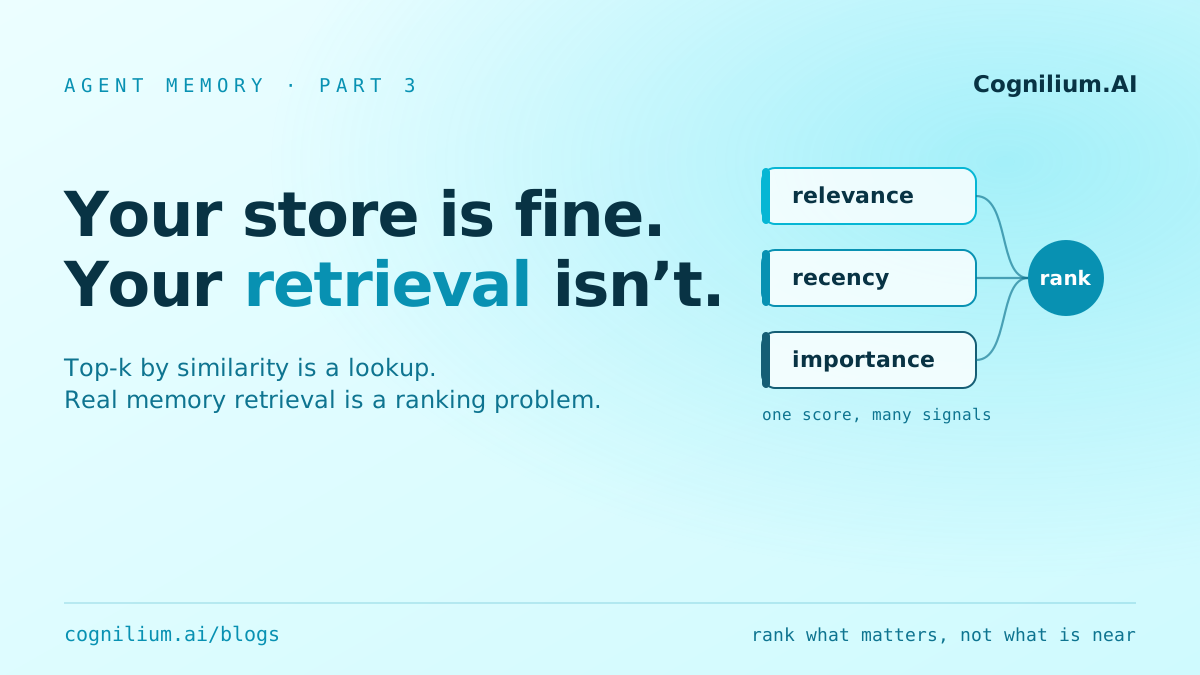
Look at how Stanford's Generative Agents worked, back in 2023, in one of the most-cited agent papers there is. When one of those agents needed to recall something, it did not pull the nearest memory by similarity. It scored every memory in its memory stream by a weighted combination of three things: relevance, the embedding similarity to the current query; recency, how recently that memory was last used, decayed over time so old memories fade unless they keep getting touched; and importance, a one-to-ten score the model itself had assigned to each memory when it was stored, rating how significant it was. The retrieved set was the top of that combined score, not the top of raw similarity. In their implementation the three weights were equal, but the structure is the point: three signals, composed into one score, and similarity is only one of them.
That is the template, and it generalizes. Recency keeps the agent from answering with a fact that has gone stale. Importance keeps a load-bearing fact from being buried under topical noise. Relevance keeps it all anchored to the question. Add the signals your own domain needs, source authority, confidence, freshness, and you are doing what information retrieval has called learning-to-rank for fifteen years: replacing a single similarity scalar with a learned or composed scoring function over many features. Every technique in the rest of this post is a variation on that one move. Once you see retrieval as ranking, the rest is just deciding which signals to score and how to combine them.
Retrieve cheap, rerank expensive
The first practical consequence of treating retrieval as ranking is that you stop doing it in one pass. Production retrieval is two stages, and they have opposite jobs.
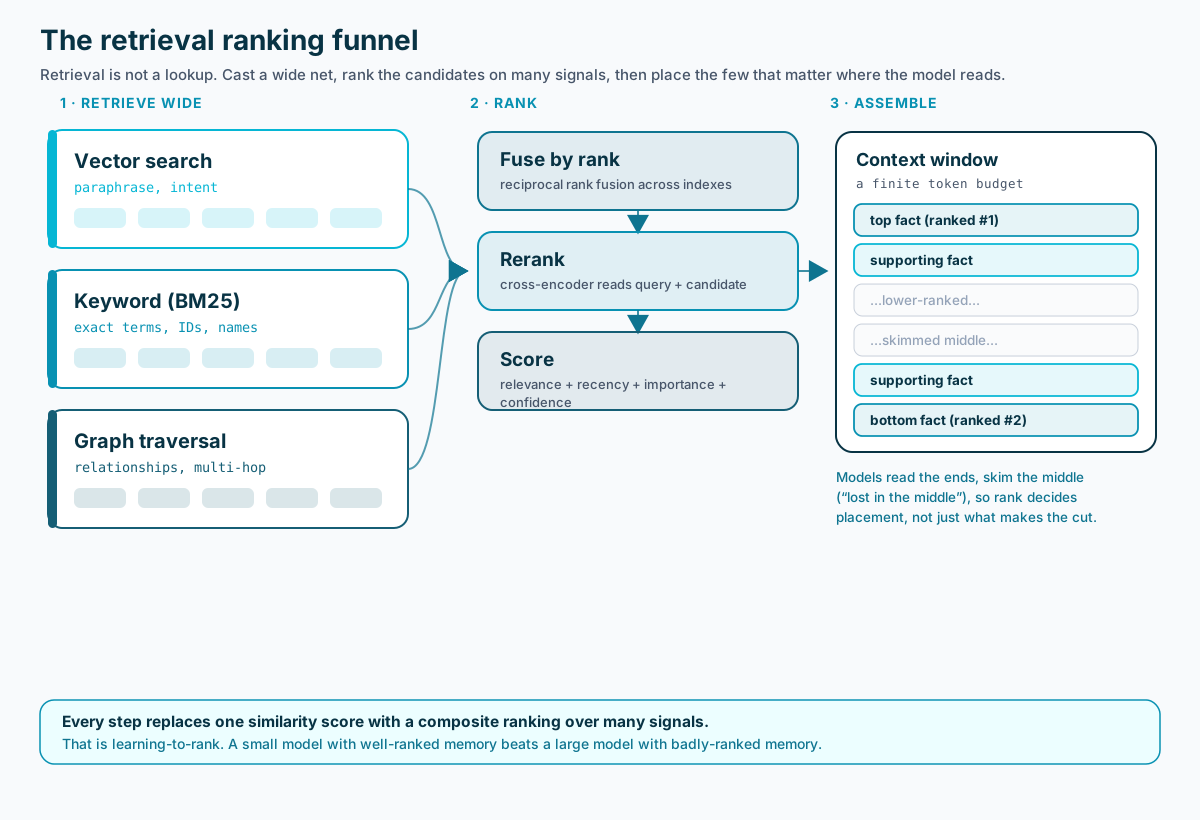
The first stage is recall. Its only goal is to make sure the right answer is somewhere in the candidate set, even if it is buried at position forty. You run it over the whole corpus, so it has to be cheap, which means an embedding nearest-neighbor search, or a keyword search, or both. These are fast because they compare pre-computed representations. They are also imprecise, for all the reasons in the last section, so you cast a wide net: pull fifty or a hundred candidates, not five.
The second stage is precision. Over that small candidate set, and only that set, you run a far more expensive and far more accurate model called a reranker. A reranker is a cross-encoder: instead of comparing two pre-computed vectors, it reads the query and a candidate together, in one pass, and scores how well that specific candidate answers that specific query. Because it looks at the pair jointly rather than at two summaries from a distance, it is dramatically more accurate. Because it cannot be pre-computed, it is dramatically slower. The independent BEIR benchmark clocked a cross-encoder rerank stage at roughly thirty times the latency of the first-stage search, which is exactly why you never run it over the whole corpus, only over the survivors of stage one.
Does the second stage earn its cost? On the evidence, yes. That same independent benchmark found that keyword search followed by a cross-encoder reranker gave the best average results across its eighteen datasets, beating plain keyword search on sixteen of them. There are good rerankers you can call as a hosted service, like Cohere Rerank, and good open-weight ones you can run yourself, like the BGE rerankers or the cross-encoder models from the sentence-transformers family. Name aside, the architecture is the lesson: cheap and wide to find, expensive and sharp to order.
One production footgun, since we have debugged it more than once. Reranker scores are not calibrated across different queries. A 0.9 on one query and a 0.45 on another do not mean the first is twice as relevant, and the vendors say so plainly. So use the scores to order candidates within a query, which is what they are for, and do not hard-code a global score threshold and expect it to mean the same thing everywhere. That single mistake silently drops good context on hard queries and floods easy ones.
One index is not enough
The second consequence of the ranking view is that you stop relying on a single index, because each kind of index is blind in a different place, and ranking is how you fuse what each one sees.
Dense vector search is strong on paraphrase and intent: it finds the passage that means the same thing in different words. It is weak on exact tokens, the rare identifier or proper noun that gets compressed away. Sparse keyword search, the venerable BM25, is the mirror image: it nails the exact rare term and whiffs on synonyms. Neither covers both, which is why serious systems run both and combine them. The wrinkle is that a keyword score and a cosine score are not on the same scale, so you cannot just add them. The standard fix is to fuse by rank rather than by raw score, a method called reciprocal rank fusion, which asks not "what score did each index give" but "how highly did each index rank this item" and merges those positions. It is simple, it is robust, and it consistently beats betting on one index alone.
Then there is the third signal the comparison posts tend to skip: graph structure. When the question is relational, "which of this entity's holdings are governed by the clause that was just amended," flat similarity retrieves each passage independently and quietly hopes that all the hops happen to land in the same top-k. A graph does not hope. It follows edges, entity to relationship to entity, so a multi-hop question is answered by traversal, by path-following, not by a prayer over a pile of similar paragraphs. Microsoft's own evaluation of a graph-based retrieval approach found it more comprehensive than plain vector retrieval on broad, connect-the-dots questions, while being honest that vector retrieval still gave the most direct answers to simple lookups. That honesty is the right takeaway: structure is another ranking signal, powerful exactly where similarity is weakest, and pointless where similarity already wins. The skill is knowing which signal the question in front of you actually needs, which is the same buyer's question we wrote a whole post on.
The hard part: ranking across memory layers into one window
Everything so far ranks candidates inside a single store. The harder, and more neglected, problem is that a real agent turn needs memory from several stores at once, and they all compete for one small window.
A single decision often needs the current task from working memory, the relevant past events from the episodic log, and the settled facts from the semantic graph, all at the same time, and the window only fits so much. So you are not ranking within one store, you are ranking across all of them and trimming the merged result to a budget. This is the discipline that the field started calling context engineering in 2025, and the framing that has stuck, from Anthropic among others, is that the context window is a finite resource and the job is to find the smallest set of high-signal tokens that gets the task done. More retrieved context is not better. Past a point it is worse, because models attend less reliably as the window fills, a degradation now commonly called context rot. You are spending a limited attention budget, and every low-value token you retrieve is a tax on the high-value ones.
Placement is part of the ranking too, and this surprises people. A well-known 2024 study, "Lost in the Middle," showed that models attend most strongly to the very start and the very end of their context and skim the middle, so the same fact that gets used correctly at the top of the window can be missed entirely when it sits buried in the middle. That means ranking does not stop at "which facts make the cut." It extends to where each one goes. The single most important retrieved fact belongs where the model actually looks, not at rank seven in the soft middle of a wall of text. Retrieval that ignores position is leaving correctness on the table that placement alone would have captured.
And two more signals belong in the score whenever the stakes are real: confidence and freshness. Do not let a low-confidence or stale memory outrank a solid current one just because it happens to be similar. Published patterns like self-reflective and corrective retrieval build exactly this in: a lightweight check that judges whether what came back is actually relevant and well-supported, and falls back to another source when confidence is low. A memory's age and its reliability are not metadata you file away. They are ranking features, and in regulated or high-stakes work they often outrank similarity outright.
What this looks like when we build it
The abstract version is "rank across signals." Here is the concrete version, from systems we have shipped, anonymized.
On a wealth-management platform we built, retrieval is deliberately not a single similarity lookup. The semantic memory is a knowledge graph in Neo4j, with six entity types and five relationship types, sitting next to a vector store of a few hundred chunks. When a question is genuinely relational, the system traverses the graph; when it is a plain similarity recall, it uses the vectors; and the results are ranked together, not chosen by one index in isolation. On top of that, every fact in the graph carries a confidence score from zero to one, and that score is a retrieval gate: the agent can set a floor and keep its shakiest memories out of its most important answers, the way a careful analyst trusts a signed filing more than a half-remembered phone call. That is relevance, structure, and confidence composed into one ranking, which is the whole thesis of this post made physical.
On Paralegent, our multi-agent legal-analysis system, the ranking shows up a level higher. The naive design would hand every one of its twenty-three agents the full case in its own context window and let them all run on everything. Instead, a router ranks which agents and which facts are even relevant to a given document and prunes the rest, so the system is not waking all twenty-three and re-sending the same large context to each. Deciding what does not need to be retrieved is as much a ranking decision as deciding what does, and moving the shared state out of every agent's window into a small structured scores table, together with that pruning, is a large part of why model calls dropped by roughly seventy-five percent. Same lesson as the graph: the win did not come from a bigger model. It came from ranking what mattered and refusing to carry what did not.
Neither system was made trustworthy by a smarter model or a longer window. Both were made trustworthy by deciding, deliberately, what should rank highest and reach the desk, and what should stay in the drawer.
How to tell retrieval is your bottleneck
A few symptoms point almost always at the retrieval layer rather than the model or the store. The agent answers with a stale or duplicate fact while the correct one sits untouched in the database. Answers get worse, not better, as you add more documents, because a wider corpus means more near-misses crowding the top of an under-powered ranking. The right answer only appears when you manually paste the exact chunk into the prompt, which is a confession that your retrieval could not find what your fingers could. And the standard reflex, raise k and retrieve more, helps for one query and then hurts, because you have added noise to a window that was already spending its attention budget.
If that sounds like your agent, the fix is to measure the right thing. The useful question is not "did we return chunks similar to the query," it is "did every fact the answer depends on actually reach the model." Frameworks like RAGAS formalize that as context precision, are the retrieved items actually relevant and well-ordered, and context recall, did the evidence the answer needed make it into the set at all. Build a small evaluation set by generating question-and-answer pairs from your own documents and checking whether retrieval surfaces the chunk that supports each answer. And treat the popular needle-in-a-haystack tests with suspicion: independent benchmarks have repeatedly found that a model's usable context is far shorter than its advertised limit, so a perfect score at finding a planted sentence tells you almost nothing about whether your real, paraphrased, multi-hop retrieval works.
The pattern under all of it is the same one we opened with. Storing memory is the easy half. Ranking it, so the few facts that matter beat the many that merely resemble the question, and land where the model will actually read them, is the half that decides whether your agent is trustworthy. It is not a better embedding model away. It is a better ranking away, and that is a design decision, not a purchase.
Is your agent's store full of correct facts it still cannot seem to use? That is a retrieval and ranking problem, and diagnosing it, then wiring hybrid retrieval, reranking, and the right scoring signals for your data, is work we do every week. Book a 15-minute call and we will tell you honestly whether your bottleneck is the store, the ranking, or the model. We work US business hours.
Share this article
Agent Memory & Context Graphs
Topic Cluster
Context graphs and durable agent memory, built on the same retrieval layer.

Mudassir Marwat
Founder & CEO, Cognilium AI
Mudassir Marwat
Founder & CEO, Cognilium AI
Mudassir Marwat's argument is that ERP systems record decisions they never optimise.