A call that answers back
Voice systems that listen, answer without an awkward gap, handle being interrupted, and speak the caller's own language. Every answer grounded in your knowledge base, and a warm transfer to a person the moment sentiment or subject says it should be one.
We prove this on our own products: VORTA runs support conversations, and ProspectVox runs outbound calls in 22 languages.
22
languages our voice product already handles
8
stages between the ring and the answer
0
answers from outside your own knowledge base

Five reasons support lines fail their callers
We do not publish a cost per abandoned call, because ours would be a guess about your business. These are the mechanics; the arithmetic is yours.
Queues that never empty
Off-hours, weekends and holiday spikes leave callers unanswered, and the queue is longest exactly when the business is busiest.
English-only coverage
Callers in other languages hit a dead end, or depend on whichever bilingual person happens to be on shift.
Latency that kills the conversation
Bolted-together speech, model and voice stacks leave gaps long enough that callers talk over the system or give up.
Answers the system invented
A generic assistant will state policies, prices and terms it was never grounded on, and a voice call leaves no time to check.
Sentiment goes unread
Supervisors see queue statistics, not the caller who is about to escalate, so the intervention comes after the complaint.
Eight stages between the ring and the answer
Voice is a latency problem wearing a language problem's clothes. Every stage here is chosen against a specific budget in milliseconds.
The call arrives
Inbound telephone or browser call lands on a voice endpoint, and a lookup resolves locale and history before anything is transcribed.
Speech to text
Streaming transcription with word-level confidence, or unified speech-to-speech when latency is the binding constraint.
Intent and sentiment
Each utterance is scored for intent against a fixed taxonomy and for sentiment polarity, in the same pass.
Dialogue policy
A stateful graph routes the call: collect the missing details, branch on intent, escalate on sentiment, or call a tool. Every transition is logged.
Knowledge retrieval
Retrieval against your indexed help centre, policies and product documentation, with reranking so the passage that answers the question wins.
The response
Generated under a strict system prompt that forbids answering outside the retrieved material — the difference between an assistant and a liability.
Text to speech
A brand-consistent voice streamed back in chunks so the caller hears the beginning of the answer while the end is still being produced.
Escalation
A threshold breach or regulated topic starts a warm transfer to a person, with the transcript and the caller's context already attached.
Six capabilities, one conversation
Many languages, routed before the first word
Locale-aware routing picks the speech model, the voice and the prompt set from the caller's number before they finish the greeting.
Latency as a design target
Unified speech-to-speech for latency-critical flows; a separate speech, model and voice chain where domain reasoning matters more than the last hundred milliseconds. The choice is per flow, not per vendor.
Grounded answers only
Every answer is grounded in your knowledge base through retrieval and reranking. Out-of-policy questions trigger an escalation rather than an improvisation.
Sentiment-based escalation
A sentiment classifier sits inside the dialogue policy. A negative threshold or a regulated topic hands the call to a person, with the context attached.
Contact-centre integrations
The platforms your team already works in, so a transfer lands in the queue they already watch and the transcript lands on the ticket they already own.
Observed in production
Per-call traces carrying transcription confidence, token counts, retrieval scores and round-trip latency, with alerts on drift rather than on complaints.
Where our voice proof comes from
Our voice work is proven on our own products, not on a stream of recent client wins.
VORTA and ProspectVox are ours, they run real conversations, and the pipeline expertise behind them is genuine. In this particular lane we have thinner delivered-engagement proof than we do in agents or retrieval, and you should know that before you buy rather than after. The honest offer is a demo on your own call flow, which is worth more than a reference call anyway.
Six kinds of call, one architecture
E-commerce
Order status, returns, refunds, address changes, cart-recovery callbacks.
SaaS
Tier-one technical support, onboarding, billing and password reset flows.
Telecom
Account services, plan changes, outage notifications, port-in status.
Healthcare
Appointment scheduling, refill intake and triage routing, on covered services with redacted logging.
Insurance
First-notice-of-loss intake, claim status, policy lookup, transfer to an agent.
Hospitality
Booking changes, service requests, loyalty lookups, concierge requests.
One language and one integration first
Voice failures are public, so the pilot is deliberately small: one number, one integration, real calls.
Week 1
Discovery and knowledge ingest
We index your help centre, product documentation and policies, and define the intent taxonomy and escalation rules with your team.
Week 2
Pilot: one language, one integration
The agent goes live on a single number with a single integration, so the first production call happens against a small surface.
Weeks 3–5
Multilingual rollout
Locale routing, per-language voices and per-language evaluation sets, cut over in waves rather than all at once.
Weeks 6–8
Full production
Remaining integrations live, dashboards and alerting on latency and sentiment drift, and a weekly evaluation pipeline.
Deep dives from our engineering team
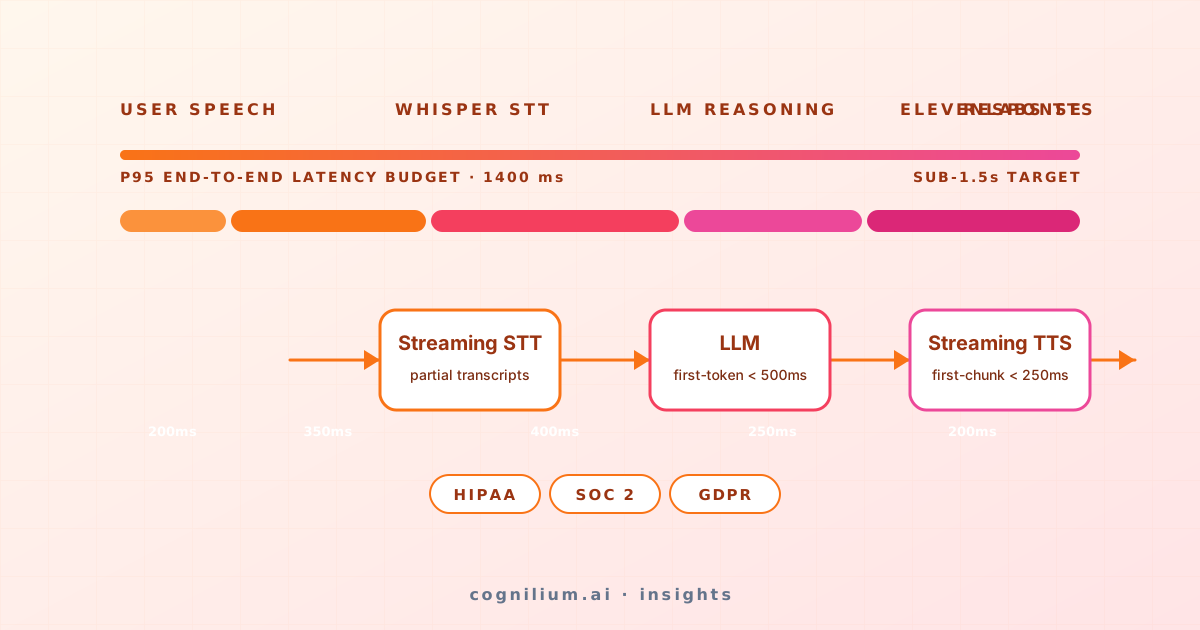
Enterprise Voice AI: Real Latency, Real Compliance, Real Money
Sub-1.5s p95 voice AI on Twilio + ElevenLabs + Whisper, designed for HIPAA and SOC2. The decisions that mattered, and the ones we got wrong twice.
Read more11 min read
Designing a Non-Scripted Voice Interview Agent on Ultravox
Voice screening that adapts to the candidate instead of reading a script — follow-ups, multi-language, and prompt structure.
Read more8 min read
Sentiment-Driven Escalation in a 22-Language Voice Support Agent
Real-time sentiment scoring drives the human handoff; full conversation context, transcript, and detected intent travel with it. Resolution starts immediately.
Read more7 min read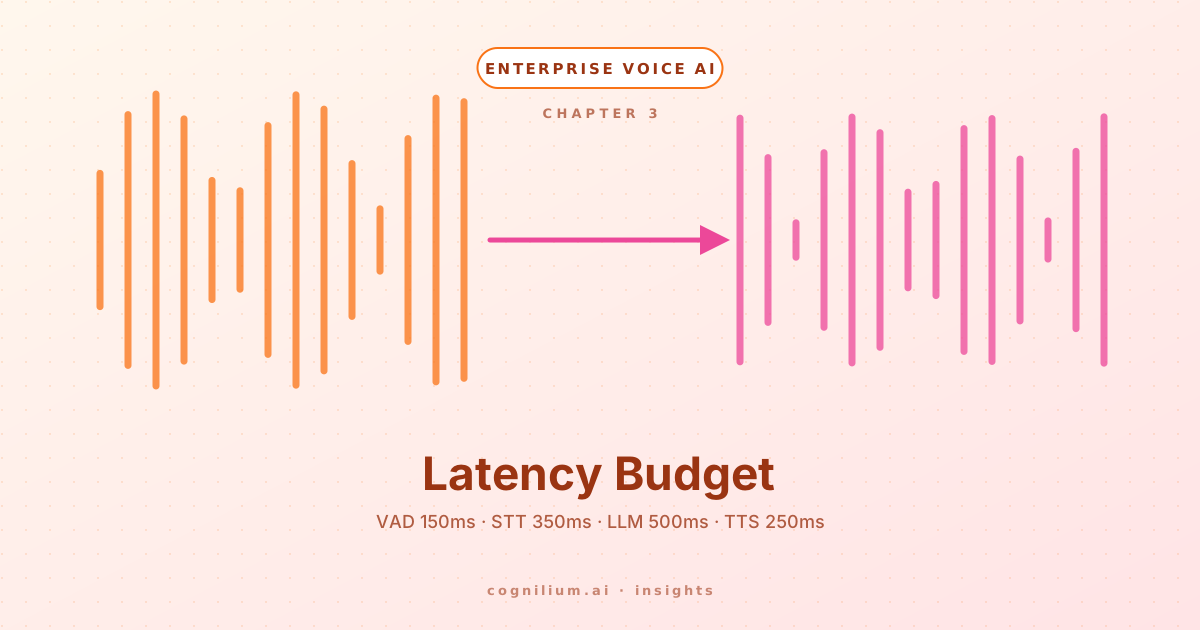
Voice AI Latency Budget Deep Dive: Where the 1.5 Seconds Goes
A line-by-line breakdown of the sub-1.5-second p95 latency budget — VAD, streaming STT, first-token LLM, streaming TTS, network — and the optimizations that buy each milestone.
Read more7 min read
Bring your five most common calls
This is our AI engineering practice
It is real work and it is where our four products came from. But what Cognilium leads with is narrower: optimization apps that run in tandem with Microsoft Dynamics 365, computing the decisions the ERP records but does not derive — the optimal price, the optimal pick path, the optimal stock level. See the optimization apps · How we build inside the ERP.