TL;DR
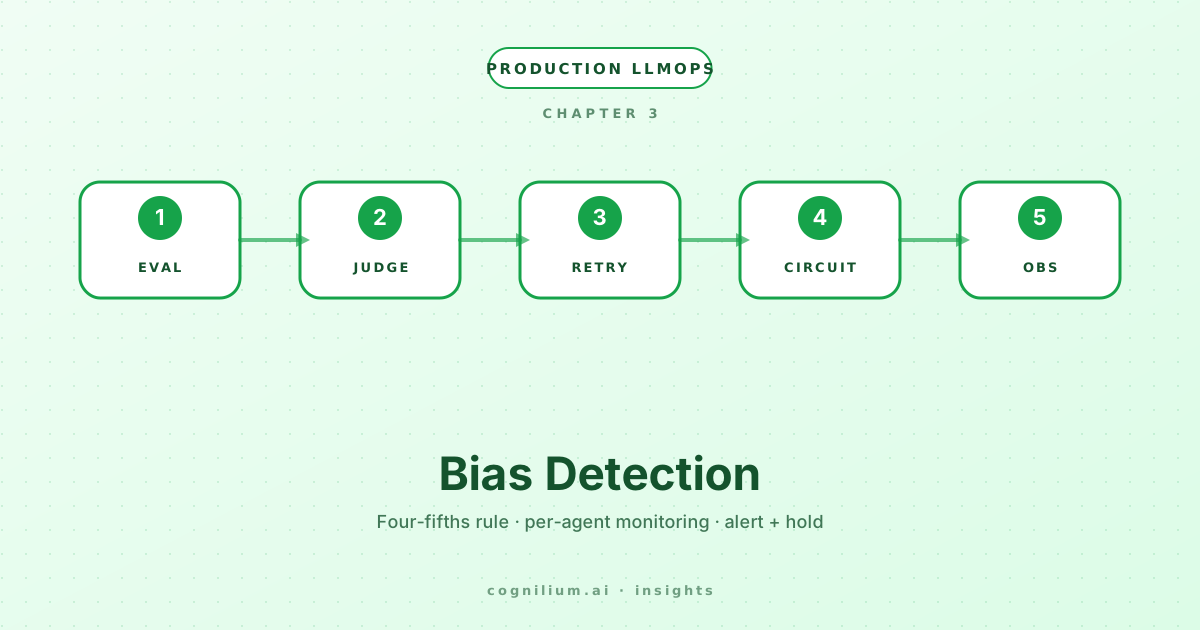
A four-agent hiring pipeline is a regulated decision system. Continuous monitoring with alerts at the four-fifths-rule disparity-impact threshold.
A four-agent candidate evaluation pipeline (resume, LinkedIn profile, GitHub, voice screen) is a production ML system whose decisions affect hiring outcomes. Bias drift in any of the four agents is not just a quality issue — it is a legal one. EEOC scrutiny on AI hiring tools is active; New York City, Illinois, and the EU AI Act have specific requirements. The monitoring layer is part of the product.
What the monitor watches
Per protected attribute, per evaluation stage, per pipeline agent: the selection rate (proportion of candidates passing each stage). The four-fifths rule says: if the selection rate for a protected group is less than 80% of the highest-scoring group's rate, that is presumptive disparate impact.
- Per agent: did the resume agent select female candidates at 78% the rate of male? Alert.
- End-to-end: did the pipeline overall select 40+ candidates at 82% the rate of <40? Within tolerance.
- Per stage: at the GitHub-analysis stage, did the rate drop disproportionately for one group? Investigate that stage.
Where demographic data comes from
Voluntary self-identification at application time. Stored in a separate table with access scoped to the audit pipeline only — never visible to the evaluation models. Candidates who decline self-ID are excluded from the audit population, not penalized; their evaluation runs identically.
What happens when an alert fires
- The affected agent goes into hold-and-review. New evaluations queue.
- Recent decisions on candidates from the affected group get human re-review (recent = past 30 days).
- The agent's recent change-set (prompt updates, model-version bumps, training-data refreshes) is reviewed against the alert window. Correlation triggers rollback.
- A bias-audit report goes to the customer's HR + legal contacts within 24 hours: what the alert was, what the action was, what the post-action selection rates look like.
Why this is necessary, not optional
Two reasons. Legal: AI hiring tools without active bias monitoring are a regulatory target. Documented monitoring with documented thresholds + external audits is the protective posture. Quality: the alert is also a model-quality signal. A bias drift in the GitHub agent often correlates with a feature regression — the agent started weighting commit frequency more heavily, which correlates with employment status in a way that disadvantaged a group. Fix the feature, fix the bias, fix the quality.
What we measured
- Alert rate steady-state: 0.5-1 alerts per quarter across customer cohort
- False-positive rate: ~30% — alert fires, investigation finds no actual drift, threshold or sample size to adjust
- Time from drift to alert: median 7 days; threshold tunable by customer based on volume
- 92% candidate satisfaction with the pipeline's perceived fairness (post-process survey)
What this does not handle
Disparate impact on attributes you do not monitor. If candidates do not self-identify a relevant attribute and you do not have demographic data, you cannot monitor. Best practice is to encourage self-ID, expand the attribute set as data allows, and document your monitoring scope clearly so blind spots are known and not hidden.
Share this article
Evaluation harnesses, judges, retries and circuit breakers — how we keep an agent system honest once real traffic arrives.

Mudassir Marwat
Founder & CEO, Cognilium AI
Mudassir Marwat
Founder & CEO, Cognilium AI
Mudassir Marwat's argument is that ERP systems record decisions they never optimise.